
The ANMAC Skills Assessment: Your Ultimate Roadmap to Nursing in Australia
For thousands of international nurses, the dream of living and working in Australia hinges on one critical document: the ANMAC Skills Assessment. Whether you are eyeing a Skilled Visa (subclasses 189, 190, or 491), seeking sponsorship from a hospital, or planning a strategic study pathway, the Australian Nursing and Midwifery Accreditation Council (ANMAC) is the gatekeeper. They determine if your qualifications measure up to Australia’s precise healthcare standards.
At Ignite Education VIC, we have assisted numerous nurses from India, the Philippines, Nepal, the UAE, and Sri Lanka in navigating this process. We understand that the paperwork can seem daunting, but having clarity is your greatest asset. Here’s an expert, streamlined guide to help with your ANMAC assessment in 2026. In this guide, we will cover the following topics:
- Introduction: What is ANMAC and its Key
- Function of ANMAC
- AHPRA vs. ANMAC
- Which stream fits you
- Guide to ANMAC skills Assessments (Step by step)
- Your Journey with Ignite education
- Final Thoughts
- FAQs
1. What is ANMAC and Why is it the Key?
ANMAC is the authority responsible for assessing the qualifications and professional experience of Registered Nurses (RN), Enrolled Nurses (EN), and Midwifery. It determines whether your nursing skills are equivalent to Australian standards, which is essential for skilled migration pathways and points tested visas.
2. The Three Main Functions of ANMAC
Understanding what ANMAC is, clarify why its assessment is so rigorous. Its role extends beyond migration into the very foundation of Australian healthcare:
- Accreditation of Study Programs: As the external accreditation body for the Nursing and Midwifery Board of Australia (NMBA), ANMAC develops standards and assesses education programs to ensure they meet national requirements. Operating independently under the National Law, it provides expert recommendations to the NMBA regarding the accreditation of nursing and midwifery providers.
- Migration Skills Assessments: ANMAC performs the vital task of assessing international practitioners for the General Skilled Migration program. They actively collaborate with stakeholders including educators and government agencies to ensure nursing standards remain responsive to evolving healthcare needs.
- Stakeholder Engagement: ANMAC builds strategic partnerships across the nursing and midwifery sectors. These partnerships ensure its accreditation standards and processes are responsive, impactful, and aligned with community needs to improve healthcare outcomes for all Australians.
3. The First Hurdle: AHPRA vs. ANMAC
The most common source of confusion for aspiring migrants is the difference between the two governing bodies. Understanding this distinction is vital to your timeline.
- AHPRA (Australian Health Practitioner Regulation Agency): This body handles your license to practise. They are concerned with clinical safety. You cannot touch a patient in Australia without AHPRA registration.
- ANMAC: This body handles your skills assessment for migration. They are concerned with your qualifications for visa purposes. The Department of Home Affairs needs this to prove you are a genuine professional.
Expert Insight: For most nurses from non-recognised countries (including India and Nepal), the journey is linear. You generally must satisfy AHPRA first (often through the OBA pathway) before you can successfully complete your ANMAC assessment for a permanent visa.
4. Which Stream Fits You?
ANMAC does not use a “one size fits all” approach. Applying for the wrong stream is the number one cause of rejection and lost fees.
4.1 The Modified Skills Assessment (The Most Common Pathway):
This is the standard route for nurses who have already secured their registration in Australia. International nurses who have successfully passed the Outcome-Based Assessment (OBA), comprising the NCLEX-RN and OSCE and are now registered with AHPRA. Since AHPRA has already vetted your English and clinical skills, ANMAC’s process is faster and requires less redundant paperwork.\
4.2 The Modified PLUS Assessment
Nurses holding a “Notice of In-Principal Approval” from AHPRA. The Strategy: This allows you to “double-track” your application, starting your migration skills assessment while your final AHPRA registration is still being processed.
4.3 The Full Skills Assessment
For Nurses registered in the UK, Ireland, USA, Canada, Hong Kong, Singapore, or Spain.Crucial Note: If you are a nurse from India or the Philippines and only hold registration in your home country, you typically cannot use this stream. You must usually gain Australian registration first.
5. Guide to ANMAC Skills Assessments: A Step-by-Step for Nurses
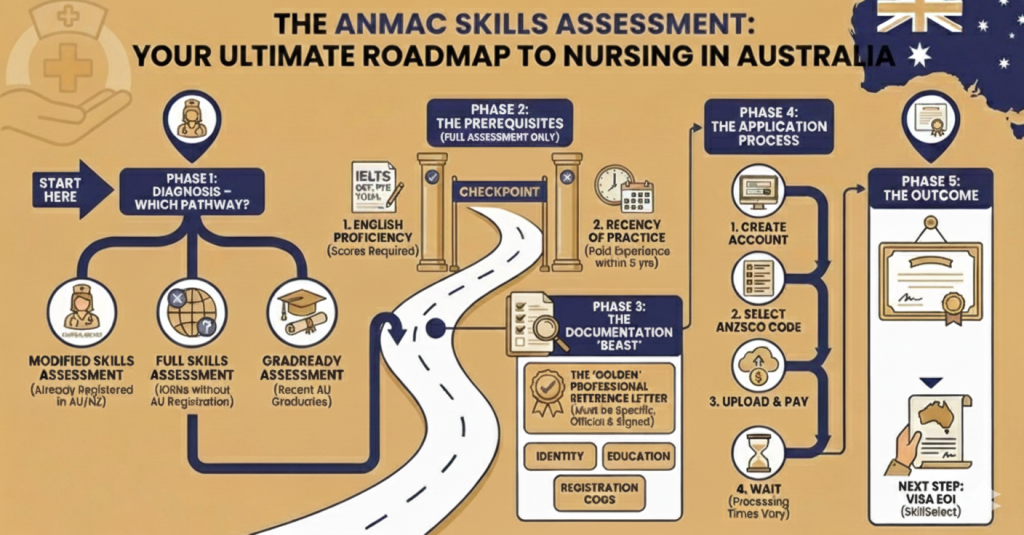
we’ve broken it down into a simple, 6-step roadmap to get you sorted.
Step 1: Choose Your “Stream”
You need to pick the right lane based on your current registration status.
- Modified Assessment
- Modified PLUS Assessment
- Full Assessment
Step 2: The Document Hunt:
This is the most critical step. Missing documents delays the process.
- Proof of ID:
- Valid Passport (Bio-page).
- Two additional government IDs (e.g., Driver’s License, Birth Certificate).
- Passport-sized photo (taken within the last 6 months).
- Qualifications:
- Graduation Certificate (Degree/Diploma).
- Academic Transcripts: These must show a full breakdown of your theory and clinical placement hours.
For “Full Assessment” Applicants Only
- Verification of Registration: You need a Certificate of Good Standing (COGS) or verification from your home country’s nursing council.
- Critical Rule: You cannot upload this yourself! It must be sent directly from your council to ANMAC via email or post.
- English Test Results: IELTS Academic: Min 7.0 in all bands / OET: Min B in all bands / PTE Academic: Min 65 overall.
The “Work Experience” Catch
To claim points for your visa, you need a Professional Reference Letter. ANMAC is incredibly strict here.
- Must include: Exact dates, hours worked, specific duties (not generic), and be signed by a Nurse Unit Manager or above.
- Contact Info: Must use an official work email (no Gmail/Yahoo) and a landline number (mobile numbers are often rejected).
Step 3: Create Your Portal Account
Head over to the ANMAC Skilled Migrant Portal to start your application. ANMAC is famous for rejecting low-quality scans. Ensure every document is:
- Colour (never black & white).
- High Resolution (Scanned at 600dpi).
- Un-edited and full size.
Step 4: Pay the Fee
Fees are subject to change every July. As of late 2025, here is what you should budget for:
- Full Skills Assessment: ~AUD $595
- Modified / Modified PLUS: ~AUD $395
(Note: These are slightly higher than older guides might tell you, so budget accordingly!)
Step 5: The Waiting Game
Once you hit submit, your application enters the queue.
- Current Timeline: 6 – 9 weeks on average.
- What happens now? ANMAC assessors verify your references and check that your home council has emailed them your verification. If they have questions, they will email you—so keep an eye on your inbox!
Step 6: The Golden Ticket
Success! You will receive a Letter of Determination via email. This document is valid for 2 years.
With this letter, you can now:
- Lodge your Expression of Interest (EOI).
- Apply for State Nomination (Visa 190/491).
- Officially prove to Australia that you are a skilled nurse!
6. Your Journey with Ignite Education VIC
Migration is not a solo sport. At Ignite Education VIC, we act as your strategic partners. We understand that the ANMAC assessment is just one piece of a larger puzzle that includes English proficiency, OBA preparation, and visa applications.
We support your journey by:
- Demystifying the OBA: Guiding you through the NCLEX and OSCE preparation required to unlock the ANMAC Modified stream.
- English Mastery: Providing targeted coaching for PTE and IELTS to ensure you hit the necessary band scores.
- Holistic Guidance: Connecting the dots between your education, your registration, and your eventual migration outcomes.
7. Final Thoughts
Australia is facing a significant nursing shortage, and the opportunities for skilled international nurses are immense. However, the system rewards those who are prepared, precise, and patient.
By understanding the relationship between AHPRA and ANMAC, and by preparing your documentation with surgical precision, you can turn this complex administrative process into the launchpad for your new life Down Under.
8. FAQs
They check the Australian Qualifications Framework (AQF), clinical placement hours, and core nursing competencies.
English ensures safe communication with patients and meets professional standards.
A strong assessment improves your EOI score, state nomination chances, and overall PR eligibility.
AHPRA registration confirms your competency, enabling a faster Modified Assessment.
- Insufficient clinical placement hours
- Incomplete transcripts
- English scores below ANMAC standards
- Missing registration verification
Ready to IGNITE Your Career?
Contact Ignite Consultancy today for a personalised consultation. Let’s take the surest step toward your registered health career in Australia.

